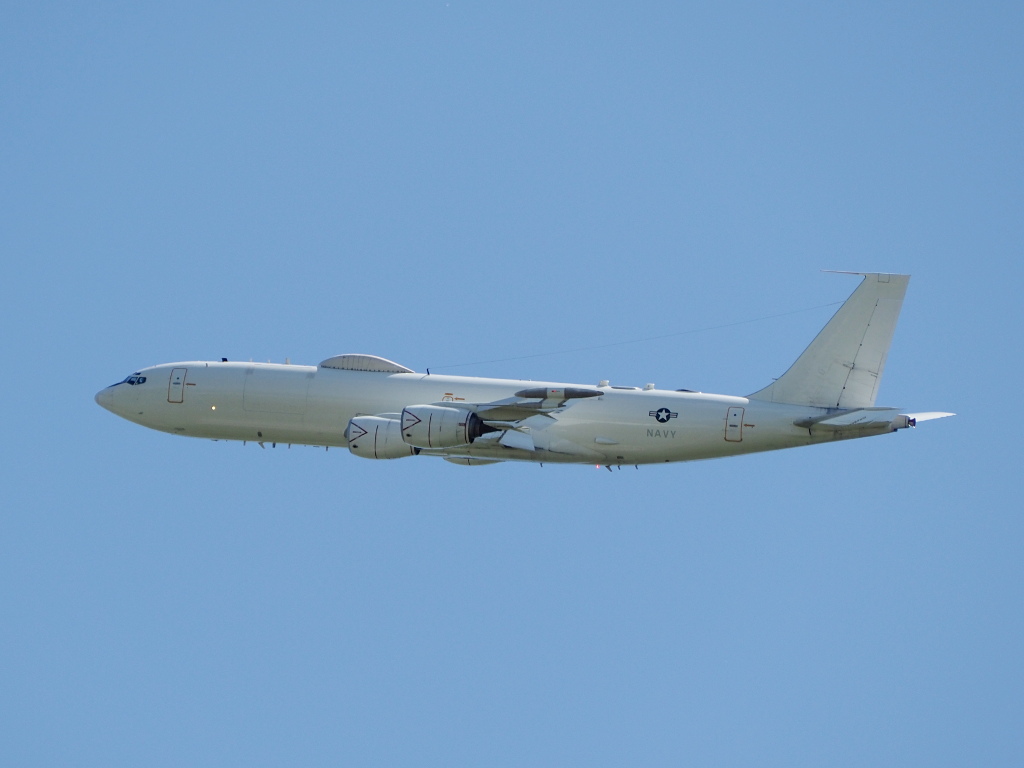
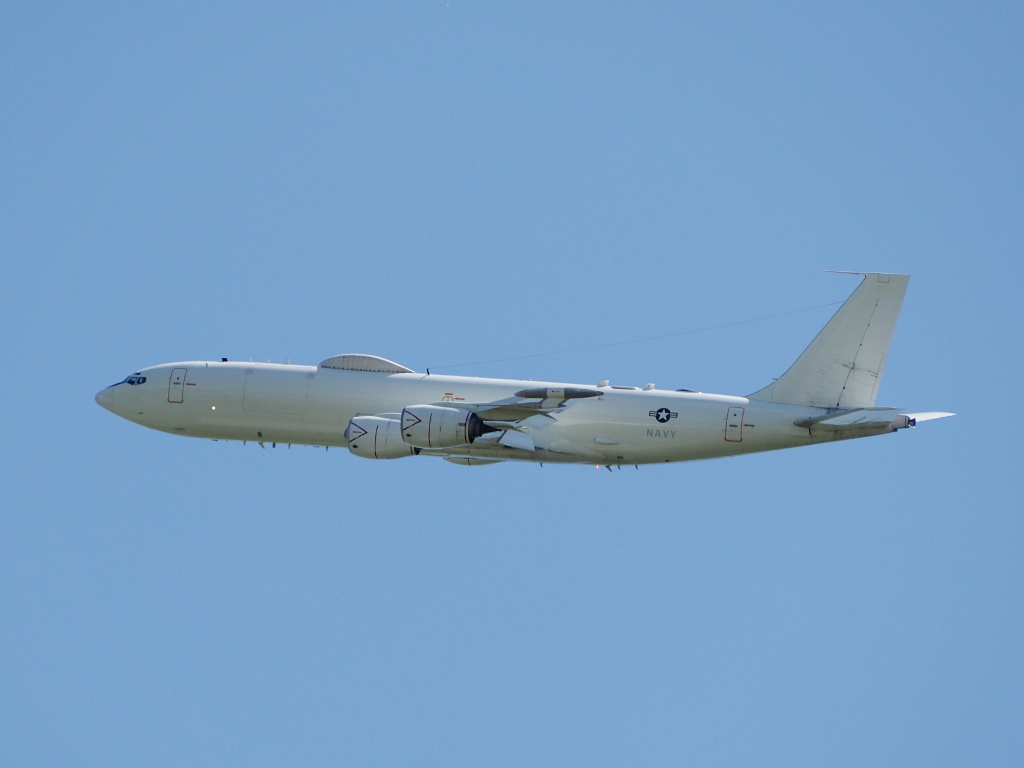
In the stratospheric silence above the vast American Midwest, a four-engine jet derived from the legendary Boeing 707-320B tirelessly traces perfect circles in the sky. This is no ordinary commercial flight; it is the cornerstone of U.S. nuclear deterrence: the Boeing E-6B Mercury.
✈️ Quick Facts & Performance
- Manufacturer: Boeing Defense, Space & Security
- Model: E-6B Mercury
- Propulsion: 4x CFM International CFM56-2A-2
- Cruise Speed: Mach 0.82 (475 knots)
- Service Ceiling: 40,000+ ft (12,192 m)
- Maximum Range: 6,600 nmi (unrefueled)
History, Genesis, and Design Philosophy
The E-6B Mercury was born from the U.S. Navy's vital need for constant communication with its Ohio-class ballistic missile submarine (SSBN) fleet. Replacing the venerable EC-130Q Hercules, the Mercury brought the TACAMO (Take Charge And Move Out) mission into the jet age. The choice of the 707 airframe was deliberate: its structural robustness and capacity for massive fuel loads and avionic systems made it the ideal platform for extreme endurance missions.
In the 1990s, the fleet was upgraded to the 'B' standard, integrating the 'Looking Glass' capabilities formerly managed by the U.S. Air Force. This transformed the Mercury into a true Airborne Command Post (ABNCP), capable of directing global nuclear forces should ground-based command centers be compromised. The design philosophy centers on absolute redundancy and operational resilience in hostile electromagnetic environments.
Aeronautical Engineering, Engines, and Aerodynamics
From an engineering perspective, the E-6B is a masterpiece of adaptation. While the fuselage maintains the classic 707 lines, the wings and engine pylons were reinforced to support the powerful CFM56-2A-2 turbofans (F108-CF-100 in military service). These engines not only provide 24,000 lbf of thrust each but were selected for their extraordinary fuel efficiency, allowing the aircraft to remain airborne for over 15 hours without refueling.
The aerodynamics are influenced by numerous pods and fairings housing secure communication systems. However, the most complex engineering challenge lies in managing the center of gravity during orbital maneuvers. When the aircraft enters its operational orbit, it must maintain a constant and precise bank angle. This maneuver requires meticulous control surface management and superior longitudinal stability, ensured by a flight control system optimized for high-altitude, low-speed handling.
Life in the Cockpit: Operating Procedures and Pilots
Flying an E-6B Mercury is an experience that blends classic aerial navigation with millimetric military precision. The flight crew, composed of U.S. Navy pilots, faces grueling shifts. Standard procedures involve takeoffs from bases like Tinker AFB in Oklahoma, followed by long transits to patrol areas in the Midwest or over the oceans.
The most critical phase is the execution of the TACAMO orbit. The pilot must tilt the aircraft into a continuous turn, maintaining a specific indicated airspeed to ensure mission systems operate at peak efficiency. It is not uncommon for pilots to perform Air-to-Air Refueling from KC-135 or KC-46 tankers to extend missions beyond 24 or 72 hours during crisis scenarios, pushing the crew's physical and mental endurance to the limit.
Real Missions, Famous Routes, and Global Operational Challenges
E-6B routes are often visible on civilian flight tracking radars with Mode-S codes revealing their presence over Nebraska or Kansas. These circular orbits, performed at altitudes between 25,000 and 30,000 feet, are the tangible sign of an ongoing mission. Beyond submarine monitoring, the Mercury serves as a relay for the National Command Authority (NCA).
Operational challenges include flying in adverse weather, where platform stability is paramount. During Global Thunder exercises, E-6Bs operate in coordination with B-52 bombers and ICBM wings, proving their ability to act as the nation's flying 'brain.' Managing air traffic in these zones requires tight coordination with civilian ATC, as the Mercury occupies blocks of airspace for prolonged periods.
| Technical Feature | Official Data |
|---|---|
| Wingspan | 145 ft 9 in (44.4 m) |
| Length | 152 ft 11 in (46.6 m) |
| MTOW (Max Takeoff Weight) | 341,000 lbs (154,675 kg) |
| Unit Thrust (CFM56) | 24,000 lbf (106.8 kN) |
| Max Fuel Capacity | 155,000 lbs (70,300 kg) |
| Operating Crew | 13 - 22 members |
The future of the E-6B Mercury seems destined to evolve toward the E-XX platform based on the C-130J-30, but the Mercury's legacy as a silent sentinel of the skies will remain etched in aviation history. It is an aircraft that does not seek the glory of air-to-air combat, but through its mere presence and perfect orbits, it ensures global stability.