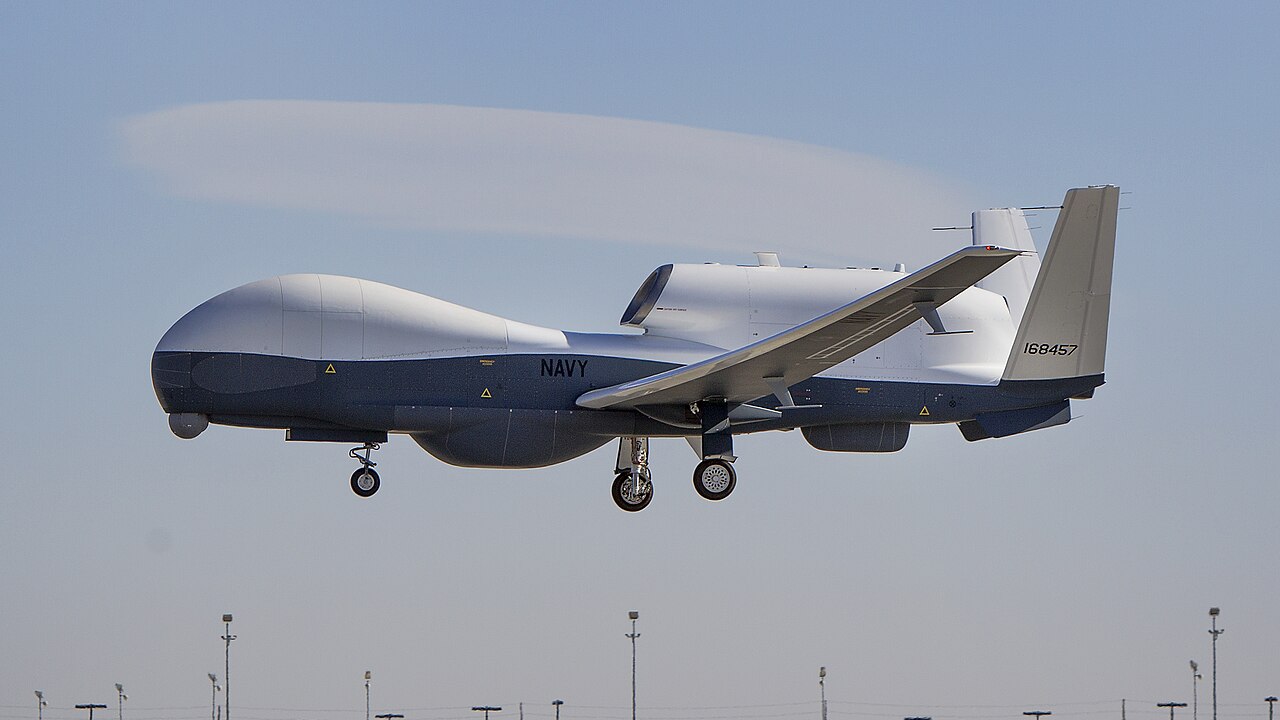
Suspended at over 60,000 feet, where the air thins and the sky's blue fades into the black of space, the Northrop Grumman MQ-4C Triton observes the world with superhuman patience. It is not merely a remotely piloted aircraft; it is a masterpiece of aeronautical engineering designed to dominate oceanic expanses, operating continuously for over thirty hours. In the critical theater of the South China Sea, the Triton represents the watchful eye of the US Navy, capable of monitoring millions of square miles in a single mission, blending the persistence of satellites with the tactical flexibility of manned aircraft.
✈️ Quick Facts & Performance
- Manufacturer: Northrop Grumman
- Model: MQ-4C Triton
- Propulsion: 1x Rolls-Royce AE 3007H Turbofan
- Cruise Speed: 320 knots (Mach 0.44)
- Service Ceiling: 60,000+ ft (18,288 m)
- Maximum Endurance: 30+ hours / 8,200 nm
History, Birth, and Design Philosophy
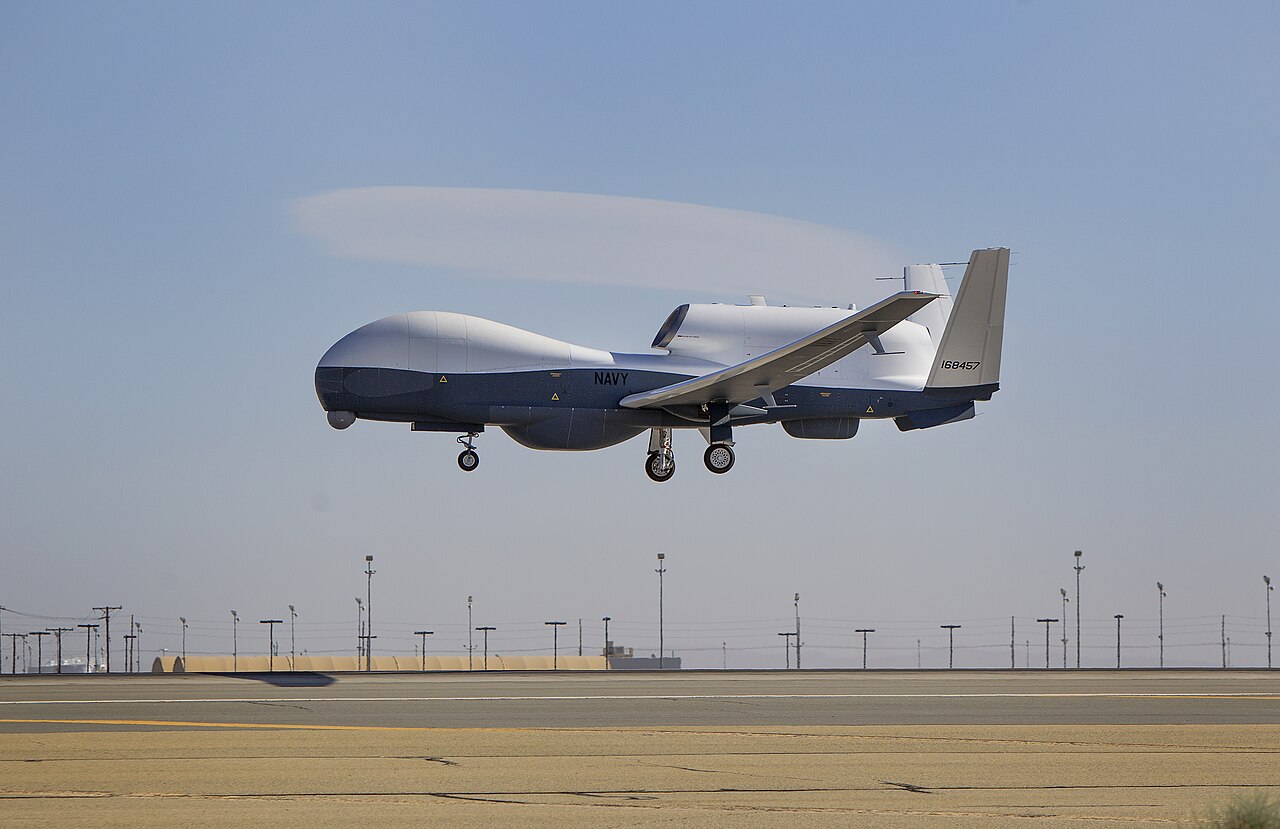
The MQ-4C Triton program was born from the US Navy's need to complement and enhance the capabilities of the P-8A Poseidon. Derived from the Air Force's famous RQ-4 Global Hawk, the Triton is not a simple naval variant but a deeply redesigned aircraft. The philosophy behind the BAMS (Broad Area Maritime Surveillance) project was clear: create a platform capable of providing persistent surveillance, reducing the workload of human crews while ensuring a constant presence over trade routes and areas of geopolitical tension. Development required years of testing to adapt an airframe born for land observation to the brutal conditions of the marine environment, where salt corrosion and sudden weather changes put every component to the test.
Aeronautical Engineering, Engines, and Aerodynamics
Structurally, the Triton is a giant with a wingspan of nearly 40 meters, larger than that of a Boeing 737. The wings have been reinforced compared to the Global Hawk to allow the aircraft to descend rapidly to visually identify targets below cloud cover, withstanding significant aerodynamic loads and potential bird strikes. The beating heart is the Rolls-Royce AE 3007H turbofan, a proven engine providing over 8,500 pounds of thrust, optimized to operate efficiently at extreme altitudes where air density is minimal. The integration of de-icing systems and lightning protection was fundamental to ensuring flight safety during ascent and descent through the storm fronts of the Pacific.
Life in the Cockpit: Operating Procedures and Pilots
Although the pilot does not physically sit on board, Triton operations require millimetric coordination. The mission crew consists of an Air Vehicle Operator (AVO), a Tactical Coordinator (TACCO), and two system operators. Pilots manage takeoff and landing with surgical precision, constantly monitoring engine parameters and control surfaces via encrypted satellite links. The main challenge for Triton pilots is 'time' management: maintaining concentration for missions exceeding 24 hours requires iron discipline. Every change in altitude or route must be calculated considering fuel consumption and jet streams which, at those altitudes, can drastically affect remaining endurance.
Real Missions and Challenges in the South China Sea
Patrol orbits in the South China Sea are among the most complex in the world. The Triton often takes off from Andersen Air Force Base in Guam or Misawa in Japan, entering crowded air corridors before reaching its operational 'station'. There, thanks to its integrated sensors, it tracks maritime traffic in real-time, identifying warships and merchant vessels via Mode-S tracking and high-resolution electro-optical sensors. The ability to remain invisible to coastal radars due to high altitude, while maintaining a total view of the battlefield, makes it an unparalleled deterrent tool. The challenges are not just tactical but environmental: Pacific typhoons require dynamic flight planning, where the aircraft must often circumnavigate massive storm cells reaching 50,000 feet.
| Technical Feature | Official Data |
|---|---|
| Wingspan | 39.9 m |
| Length | 14.5 m |
| Max Takeoff Weight (MTOW) | 14,628 kg |
| Engine | Rolls-Royce AE 3007H |
| Unit Thrust | 37.7 kN |
| Max Fuel | 7,847 kg |
| Crew (Remote) | 4 members |
The future of the MQ-4C Triton is set to expand further, becoming the hub of the global surveillance network. With the introduction of new electronic intelligence capabilities and the refinement of autonomous flight systems, this silent giant will continue to roam the skies, ensuring that no movement on the oceans remains in the shadows. Its legacy will not be measured in battles won, but in the stability guaranteed by its constant, invisible presence.