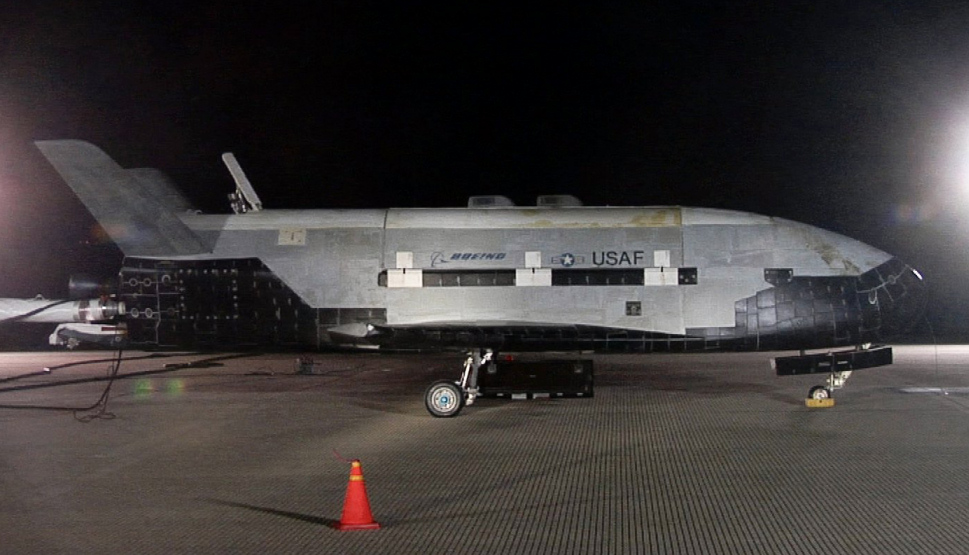
When the silence of the orbital vacuum is broken by the sonic boom over the Florida skies, the Boeing X-37B ceases to be a spacecraft and transforms into the most sophisticated hypersonic glider ever conceived by man. The atmospheric reentry phase of the Orbital Test Vehicle (OTV) represents the pinnacle of contemporary aeronautical engineering.
✈️ Quick Facts & Performance
- Manufacturer: Boeing Phantom Works
- Model: X-37B OTV
- Propulsion: Aerojet Rocketdyne AR2-3 (Hydrazine/NTO)
- Speed: Mach 25 (Reentry) / 300 kts (Landing)
- Ceiling: Low Earth Orbit (LEO)
- Endurance: Over 900 days in orbit
History, Origin, and Design Philosophy
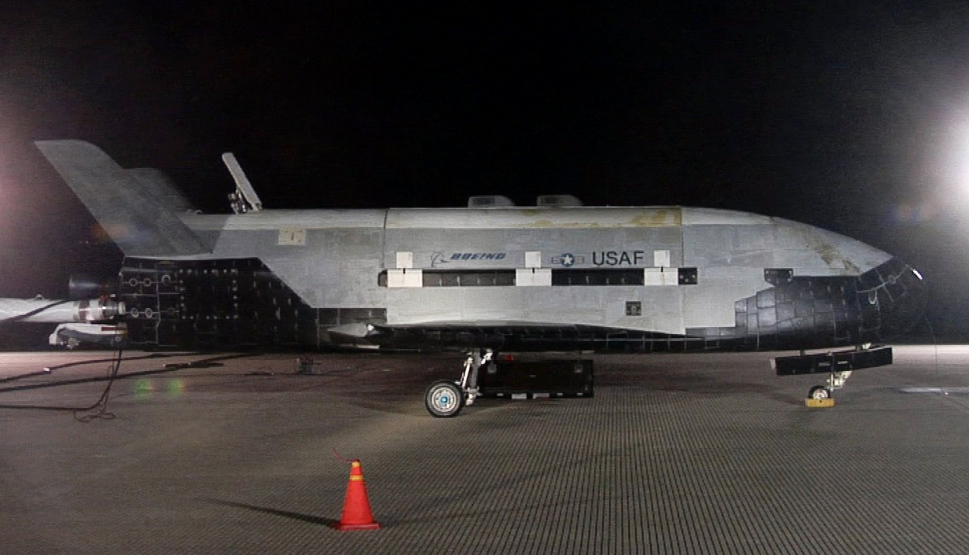
The X-37B was born from the legacy of the Space Shuttle program, with the goal of creating a reusable, unmanned platform capable of operating for years in orbit and returning autonomously to a conventional runway. Originally a NASA project, it later moved under DARPA and finally the US Space Force. This vehicle embodies the concept of 'persistent operations.' Its design philosophy is based on thermal resilience and autonomous navigation precision, eliminating the risks associated with human presence in long-duration missions.
Aeronautical Engineering, Engines, and Aerodynamics
From an aerodynamic perspective, the X-37B is a 'lifting body' with clipped delta wings, designed to handle a flight regime ranging from Mach 25 in a vacuum to subsonic approach speeds. Thermal protection is provided by next-generation ceramic tiles (TUFI) and reinforced carbon-carbon panels. The AR2-3 main engine is used exclusively for orbital maneuvers and the de-orbit burn; once descent begins, the vehicle becomes a pure glider. Kinetic energy management is handled through a series of high-angle-of-attack 'S-turns,' essential for dissipating heat and speed before intercepting the final glide slope.
Life in the Cockpit: Operating Procedures and Pilots
While there is no pilot on board, the X-37B possesses a triple-redundant avionic 'brain' that acts with the expertise of a veteran test pilot. During the reentry phase, the Guidance, Navigation, and Control (GNC) system processes data from inertial sensors and GPS to align with the Kennedy Space Center runway. A crucial aspect of modern aeronautical integration is the activation of the Mode-S transponder during descent. This allows civilian and military flight controllers to monitor the drone's position via ADS-B (Automatic Dependent Surveillance-Broadcast), ensuring separation from other aircraft as the X-37B crosses high-altitude commercial routes.
Real Missions and Operational Challenges
OTV missions have shattered every record for space endurance, with the latest mission exceeding 900 days. The greatest operational challenge lies in managing the 'dead-stick landing': since there are no engines for a go-around, the approach must be perfect on the first attempt. Tracking via Mode-S signals has become a standard element for flight safety, allowing unprecedented situational awareness during the transition from space to the National Airspace System (NAS).
| Technical Specification | Official Data |
|---|---|
| Wingspan | 4.5 meters |
| Length | 8.9 meters |
| MTOW (Takeoff Weight) | 4,990 kg |
| Payload | Pickup truck bed size |
| Crew | 0 (Autonomous) |
The future of the X-37B and its successors promises an ever-closer fusion of aeronautics and astronautics. As the vehicle gently touches down on the Cape Canaveral runway, its ADS-B signals mark not just the end of a mission, but the beginning of an era where space becomes a natural extension of our sky.